
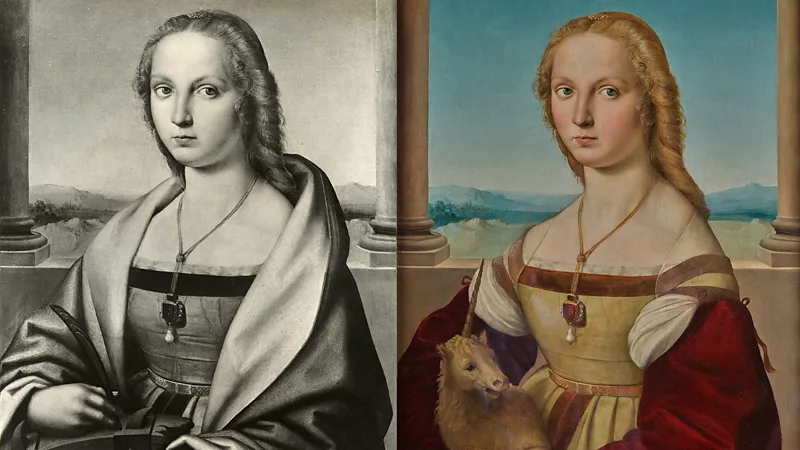
Overpainted images found hidden inside Raphael’s Portrait of a Young Woman with a Unicorn help unlock the mystery behind it. They also show the ways that the image of the ideal woman has been carefully controlled by men through the centuries.
What do you get when you cross a mythical creature from folklore with a medieval torture device? The answer is one of the most intriguing portraits in all of art history: Raphael’s Portrait of a Young Woman with a Unicorn – a restless masterpiece that refuses to stay still.
Originally painted by the precocious Italian master between 1505 and 1506, the work’s surface has, over the centuries, repeatedly been painted over, each time to tell a different story. While the true identity of the woman that Raphael depicts remains a mystery to this day, she has been made to embody shifting ideals of femininity: from a chaste avatar of marital fidelity to a pious saint sitting beside a spiked execution wheel. The painting has, quite literally, struggled to keep its story straight.